Best Lemlist Alternatives 2026: Pricing, Limits & the API Option
lemlist's per-user pricing and signal credits, who the platform is built for, and when an agent-first API priced per account, capped at $3,000 a month, is the better tool.
By The LinkupAPI Team · Reviewed by Eliott · Updated
lemlist is having a good year. Search interest is up 183 percent in twelve months, and the product covers email, LinkedIn, calls and SMS from one screen. So why search for a lemlist alternative at all?
Usually because they hit one of two walls. Their outreach needs to run inside their own product, not in a sales tool. Or the bill climbs with every user and every signal credit. Neither wall means lemlist is bad. It means lemlist is doing a different job.
Key Takeaways
- lemlist bills per user: $69 a month for email volume plans, $109 per user for Multichannel Expert, with signals and lookups metered in credits on top.
- It is a finished outbound platform for sales teams. It is not built to be embedded in your product or driven by an agent.
- An agent-first API prices per connected account, from $5.50 down to $4.50 with unlimited outreach, and the bill stops at $3,000 a month for unlimited connected accounts.
- A team of 3 to 20 reps that wants one UI should stay on lemlist. Builders and multi-account operators should price the ceiling.
What Is lemlist?
lemlist is a multichannel outbound platform for sales teams that finds leads in a 650M+ database, sequences email, LinkedIn, calls and SMS, and manages replies in one inbox. It is a complete application: you log in, build a campaign, and reps work the pipeline from the lemlist screen.
It has grown well past cold email: an email and phone finder, a built-in dialer, lead scoring, and a signal engine for hiring, funding and job changes. Developers get an API, a CLI and an MCP server, plus Zapier, Make, n8n and Clay.
How Much Does lemlist Cost in 2026?
lemlist prices its Email plan by monthly sending volume and its Multichannel Expert plan per user, at $109 a month billed monthly or from $87 on a yearly plan. Signals, lookups and calling are metered in credits beyond the 400 included per user. Enterprise is annual only with a five-seat minimum.
- Email plan: $69 a month for 50,000 emails, $89 for 100,000, $159 for 200,000, $359 for 500,000, $659 for 1,000,000. Unlimited users and senders, no included credits.
- Multichannel Expert: $109 per user per month. Five senders per user, unlimited messages, 400 credits and 400 calling minutes per user each month. WhatsApp is a paid add-on.
- Enterprise: custom price, annual billing, minimum five seats, 800 calling minutes.
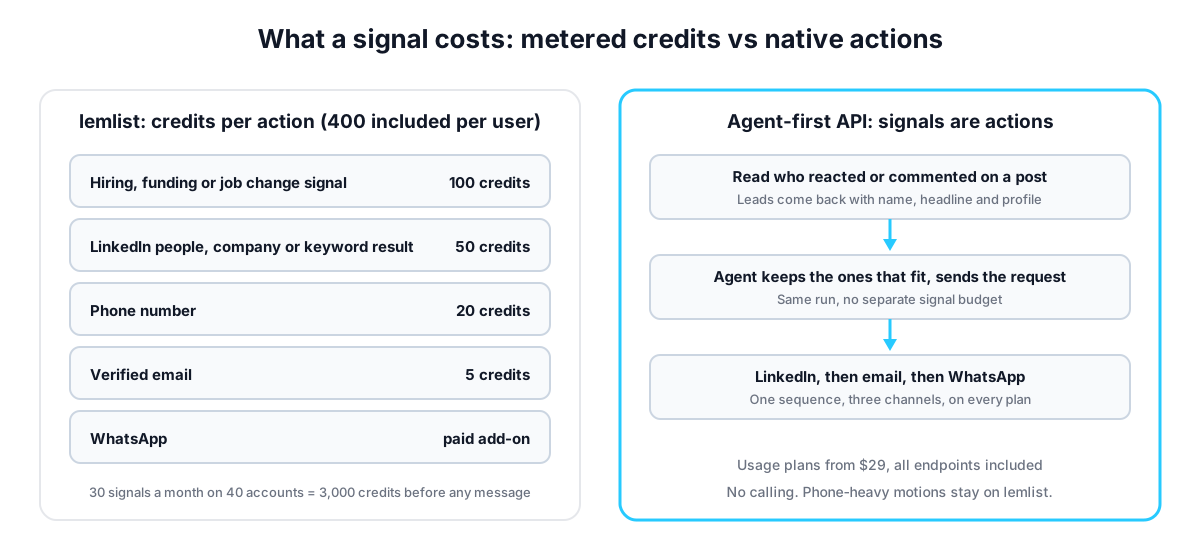
Credits are where the meter runs. A verified email costs 5 credits, a phone number 20, a LinkedIn people or keyword result 50, and a successful hiring, funding or job change signal 100. Extra credits are $0.01 each.
Watching 40 accounts for job changes and catching 30 signals a month burns 3,000 credits before a single message goes out. Fine for a rep. Heavy for a product doing it for every customer.
Who Is lemlist Built For?
lemlist is built for a sales team that wants to run outbound from one interface, with reps as the users. It sits next to Instantly and Smartlead on the email side and La Growth Machine on the multichannel side. All sell a finished workspace, priced per seat or per volume. It is not built for three other jobs.
- Not an embedded layer. If your SaaS needs a "message this lead on LinkedIn" button, lemlist expects your users to hold lemlist seats.
- Not agent-driven. The API and MCP server are real, but the logic lives in campaigns a human designs.
- Not flat at scale. Every rep is a user. Every signal is credits. The bill tracks headcount and activity, by design.
Why Is an Agent-First API a Different Job?
An agent-first API gives the outreach actions to software instead of a rep: search people, pull who reacted to a post, send a connection request, follow up by email or WhatsApp. The agent, or your product, decides who, what and when. There is no campaign builder because the caller is the campaign builder.
Here is what it looks like for a builder. A two-person team runs a recruiting SaaS with 60 agency customers. Each customer connects their own LinkedIn account inside the product. The product finds candidates by title and location, sends a connection note, and moves to email if nothing lands in five days. One API, 60 accounts, $325 a month.
When we tested both paths, the first hour told the story. In a workspace tool it went into building a campaign. Through an API it went into one prompt.
How Do Signals and Channels Compare?
lemlist meters signals per event, at 100 credits for a hiring, funding or job change hit and 50 credits per LinkedIn keyword result. An agent-first API treats post reactions and comments as a native action: read who engaged with a post, get leads back, act on them in the same run. No separate signal budget.
Channels differ too. lemlist runs email, LinkedIn, calls and SMS, with WhatsApp as an add-on. The API runs LinkedIn, email and WhatsApp in one sequence, and does not dial. A phone-heavy motion settles it in lemlist's favour.
Someone who commented on a rival's launch post yesterday is warmer than any list. Pulling those 300 people, keeping the 40 that fit, and opening 40 conversations while the post is fresh is one prompt for an agent.
As one founder put it during a test: "I do not want to build a campaign. I want the agent to tell me who it messaged and why, every morning." That is the whole shift.
What Changes When Pricing Has a Ceiling?
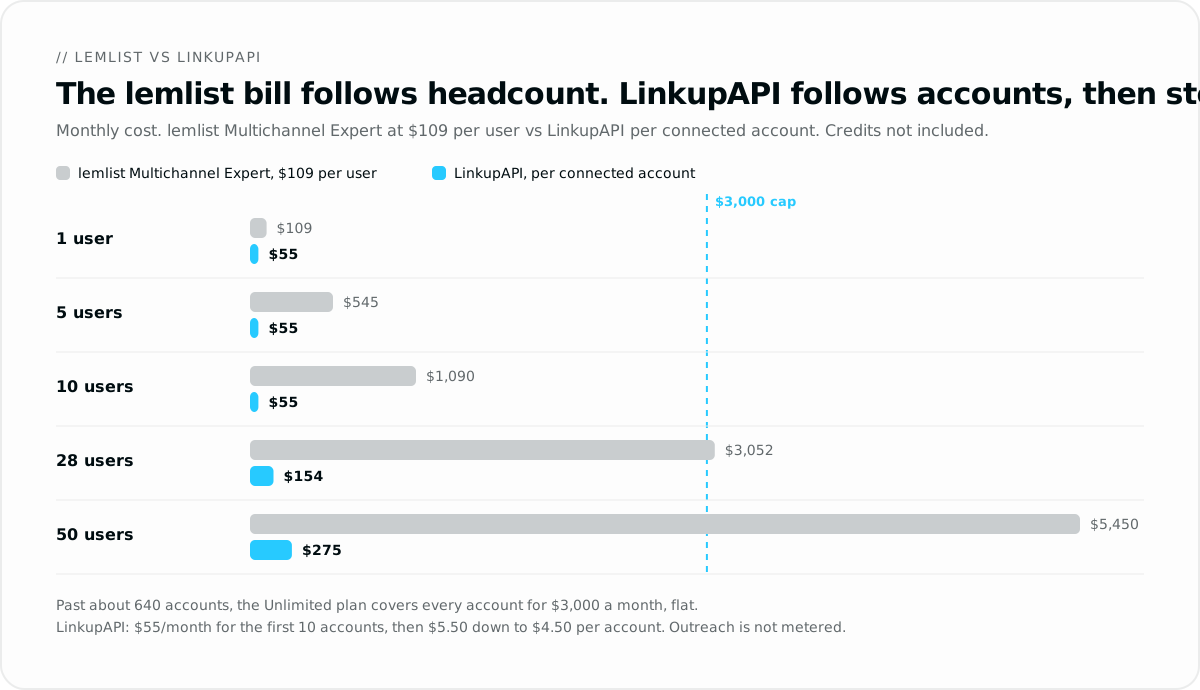
The one thing no per-user tool offers is a ceiling. LinkupAPI charges per connected account: $55 a month for the first 10, then $5.50 each up to 50, $5.00 up to 200 and $4.50 beyond, with unlimited outreach on every account. The bill is capped at $3,000 a month, where the Unlimited plan covers unlimited connected accounts. Past about 640 accounts, adding one costs nothing, whether you connect 700 or 5,000.
One more thing about the word unlimited. No tool in this category sells a true unlimited plan. HeyReach's top tier, for example, is capped at 500 senders under a fair-use policy, in the words of its own blog, and the terms above that are negotiated. One agency running about 900 accounts told us its bill there was already above $3,500 a month. The $3,000 Unlimited plan has no fair-use cap on connected accounts. That is the whole point of the ceiling.
Run lemlist's Multichannel Expert against user counts:
- 5 users: $545 a month, with a dialer and an inbox for each rep. Five connected accounts here cost $55, with no rep workspace.
- 10 users: $1,090. Ten accounts here cost $55. If those are reps who want a UI, lemlist is still the right buy.
- 28 users: about $3,050 monthly, or 34 users on the $87 yearly rate. 28 accounts here cost $154.
- 50 users: $5,450, plus credits for signals and lookups. 50 accounts here cost $275.
Be fair to lemlist here. It bills users, not connected accounts, and each user runs five senders, so five reps can run 25 senders for $545. The same 25 accounts here cost $137.50, without the dialer, the database or the shared inbox.
The ceiling matters in two cases: outreach runs inside a product, so "users" are your customers, or one agency operates many accounts and pays per identity today. In both, the meter is the problem.
If your account count is heading that way, price it now. Get your API key at linkupapi.com and run the numbers.
The Honest Case for Staying on lemlist
Stay on lemlist if your users are reps, not code. The database, sequencer, dialer, deliverability tooling and shared inbox are one subscription, and they work together. An SDR team of 3 to 20 people gets more from that bundle than from any API.
Stay if calling is part of the motion. Stay if email deliverability is your main risk; lemlist has spent years on warmup and sending infrastructure.
And stay if nobody on the team wants to write a prompt. This is the trade-off, said plainly: you give up the workspace to get control an agent can use.
You are probably thinking the API path needs an engineer. It needs one API key and an MCP connection in the agent you already use.
How Do You Run a Side-by-Side Test?
Run the same multichannel sequence both ways for two weeks: one lemlist campaign, one agent prompt, same 50 accounts, same message. Compare replies, time spent building, and the invoice at your real account count. The setup on the API side takes about ten minutes.
- Get your API key at linkupapi.com. Every endpoint is on every plan.
- Connect the MCP server in your agent. In Claude, Settings, then Connectors. The same server works with any MCP-compatible agent; ChatGPT uses Custom GPT Actions.
- Paste a prompt that runs the sequence: "Find 50 VP Sales at Series A SaaS companies in Berlin. Send each a connection request with a two-line note. For anyone who has not accepted in 5 days, find their work email and send one follow-up. Report replies every morning."
- Turn the conversation into a scheduled routine, then compare against the lemlist campaign on day 14.
It is the same test we ran for Unipile and Zernio. If the goal is embedding outreach in your own product, start with connecting LinkedIn to your product.
Other Lemlist Alternatives Worth Comparing in 2026
Most people searching for a lemlist alternative are not looking for an API. They want another sequencer with a different pricing shape or a different channel mix. Here are the five that come up most often in the same evaluations, with the honest reason each one wins or loses.
- Instantly: the cold-email volume play. Sending accounts and warm-up are bundled, so agencies running dozens of inboxes pay less per mailbox than on lemlist. It is email only, so every LinkedIn step needs a second tool.
- Smartlead: same email-first philosophy as Instantly, with inbox rotation and a white-label option agencies like. No native LinkedIn actions.
- Saleshandy: cold-email sequences with a built-in lead database and a strong deliverability focus. Simpler than lemlist, cheaper per seat, and again email-centric.
- La Growth Machine: the closest match in scope, with LinkedIn, email and X in one sequence. Pricing is per seat, so it scales the same way lemlist does.
- HeyReach: LinkedIn-first, built to run many sender accounts inside one campaign. Popular with agencies, priced per sender. See our HeyReach pricing breakdown.
LinkupAPI belongs in a different column. It is not a sequencer you log into but an API your own agent or product calls for LinkedIn and email actions, with per-account pricing capped at $3,000 a month. If the tools above solve your problem, pick one of them. If the problem is that none of them run inside your product, keep reading the test below.
Frequently Asked Questions
How much does lemlist cost?
lemlist's Email plan starts at $69 a month for 50,000 emails and scales with volume up to $659. Multichannel Expert is $109 per user per month, or from $87 yearly, with 400 credits and 400 calling minutes per user. Enterprise is custom, annual only, with a five-seat minimum. Extra credits cost $0.01 each.
Is lemlist safe for my LinkedIn account?
lemlist runs LinkedIn steps such as visits, invites and messages through its own automation with volume limits per sender, and lets you work from LinkedIn through its extension. Like any automation, safety depends on pacing and volume. Keep daily actions modest, warm up new senders, and the account stays in good standing.
Does lemlist have an API?
Yes. lemlist offers an API key with documentation, a CLI and an MCP server, plus native integrations with Zapier, Make, n8n, Clay and CRMs such as HubSpot, Salesforce and Pipedrive. The API is designed to feed and read lemlist campaigns, not to embed outreach in a third-party product under per-account pricing.
What is the best lemlist alternative for AI agents?
For an agent that decides who to contact and on which channel, an agent-first API is the better fit: LinkedIn, email and WhatsApp actions through MCP, post reactions and comments as leads, and per-account pricing capped at $3,000 a month on the Unlimited plan, with unlimited connected accounts. LinkupAPI is built for that job. lemlist remains the better tool for rep-driven teams.
lemlist vs LinkupAPI: what is the difference?
lemlist is a finished outbound workspace priced per user, with signals and lookups metered in credits. LinkupAPI is an API an agent or a product calls, priced per connected account from $55 a month for the first 10, with a $3,000 ceiling for unlimited accounts. One is a tool reps use. The other is a layer software uses. They rarely compete for the same buyer.
If your outreach is about to live inside a product or across many accounts, the ceiling is the number to check. Get your API key at linkupapi.com, connect it to your agent, and run one real sequence before you decide.
