Best Zernio Alternative 2026: Pricing, Limits & Competitors
Zernio handles publishing well. This guide covers the other job: LinkedIn outreach that official access does not include, and the API model that does.
By The LinkupAPI Team · Reviewed by Eliott · Updated
Most people searching for a Zernio alternative want a different publishing API: something to post, schedule, and analyze across social channels. If that is you, the honest answer is that the closest rivals are SocialAPI, Ayrshare, bundle.social, and Postiz, and Zernio holds up well against all of them.
This page is for a different reader: the team that connected Zernio for LinkedIn and then discovered that publishing is not the job they needed done.
Official OAuth access to LinkedIn covers posting and analytics. It does not include connection requests or direct messages to prospects. If your product or agent is supposed to reach new people, that is a different job with a different access model.
Key Takeaways
- Zernio is a publishing and messaging API across 16 channels, with usage-based pricing: 2 free accounts, then $6, $3, and $1 per account as volume grows.
- On LinkedIn, official OAuth covers posting and analytics, not outreach. Connection requests and prospect messaging need a member session.
- LinkupAPI covers that outreach side: LinkedIn actions plus email and WhatsApp in one sequence, priced per connected account and capped at $3,000 a month on the Unlimited plan.
- The two are different jobs. Some products run both.
What Does Zernio Actually Cover?
Zernio is a social media and messaging API that publishes, analyzes, manages ads, and handles DMs across 16 channels through hosted OAuth. It started as getlate.dev and rebranded in 2026. You connect an account once, then publish or read data through one SDK.
It is built for developers and AI agents. There is an MCP server, a TypeScript SDK, and in public agent-stack writeups it shows up as the publishing tool in Claude Code setups.
The reviews are consistent on one point: integration speed. Founders describe going live in under an hour, and the SDK gets named as the reason.
For its job, multi-channel publishing inside a product, it is a solid pick.
Why Do Teams Look for a Zernio Alternative?
Two different searches hide behind the same keyword. Publishing teams compare Zernio against other posting APIs on price and platform coverage. Outreach teams discover that the LinkedIn side of Zernio stops where their use case starts. This page focuses on the second group.
The publishing comparison. Rivals compete on account limits and per-account fees. If that is your evaluation, SocialAPI is the closest like-for-like and gets its own section below. bundle.social, PostPeer, and Ayrshare are the pages to read after it.
The outreach discovery. A founder builds a sales tool, connects LinkedIn through official OAuth, and then looks for the endpoint that sends a connection request. It is not there. Not because Zernio forgot it, but because official access does not include it.
What Can You Not Do on LinkedIn Through Official Access?
Official OAuth integrations cover publishing posts, reading analytics, and managing comments on your own content. They do not include sending connection requests, messaging people outside your network, or browsing profiles on behalf of a member. No publishing API offers those, whatever its pricing page says.
That is why outreach tools work differently: through the member's own authenticated session, at the pace LinkedIn allows from one session. The access model changes what matters in a vendor. OAuth apps live or die on API quotas. Session-based platforms live or die on keeping sessions stable and looking normal.
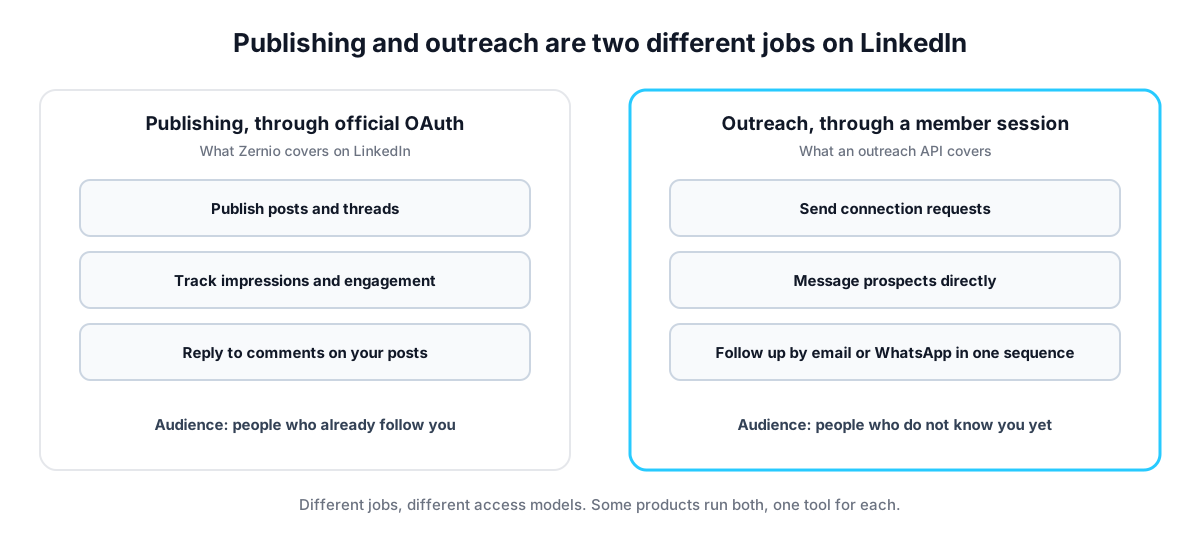
The practical consequence: if your roadmap says "post our content", Zernio covers it. If it says "reach 200 prospects a week", you need an outreach API next to it, or instead of it.
Which Publishing API Is the Closest Zernio Alternative?
If you are staying in the publishing job, SocialAPI is the one to compare first. It is a unified REST API for developers and AI agents that publishes, reads, and replies across 11 platforms: Instagram, Facebook, Threads, TikTok, YouTube, X, LinkedIn, Telegram, WhatsApp, Google Business Profile, and Zalo. Comments, DMs, mentions, and Google reviews land in one inbox with one schema, one webhook delivers every event, and the MCP server exposes 75+ tools to Claude, GPT, or Gemini.
Where it beats Zernio is the billing unit. Zernio meters every connected account: $6, then $3, then $1 per account per month. SocialAPI bills per brand, and one brand holds one account per platform. A customer posting on four networks is four accounts on Zernio and one brand on SocialAPI. Posts and interactions are unlimited on every paid tier, reads are free on all of them, and there is no extra counter:
- 10 brands on four networks: $29 a month on SocialAPI, about $138 for the 40 accounts on Zernio's rates.
- 50 brands, the $109 Full Send plan: 200 accounts, about $418 a month on Zernio.
- 200 brands, the $349 Empire plan: 800 accounts, about $1,018 on Zernio.
- Free tier: 2 brands, 10 posts and 50 interactions a month, no card required.
The gap shrinks if each customer connects a single account, and Zernio's $1 tier catches up past a few hundred of them. Zernio also keeps two real advantages: five more channels (Pinterest, Reddit, Bluesky, Discord, Snapchat) and an ads API across Meta, Google, TikTok, and LinkedIn. On LinkedIn specifically, SocialAPI publishes from member accounts but reads comments only on organization pages, still in beta, while Zernio reads and replies to comments where LinkedIn exposes them. Pick SocialAPI for a cheaper, inbox-first publishing layer priced by brand; keep Zernio if channel breadth or ads are the job.
One thing does not change between them. Both connect LinkedIn through official OAuth, so both stop at publishing and analytics. SocialAPI says so plainly in its own guide to what the LinkedIn API does not let developers do. Neither is an outreach alternative, which is the rest of this page.
When Is LinkupAPI the Right Alternative?
LinkupAPI is a B2B outreach API for products and AI agents: connect a LinkedIn account, send connection requests and messages, then follow up by email or WhatsApp in the same sequence. It replaces Zernio only when outreach is the job. For publishing, it does not compete.
What that covers in practice:
- A sales tool sends 80 connection requests a week per connected seat, each with a note.
- A recruiting product messages candidates on LinkedIn, then emails the ones who do not reply within a week.
- An agent runs a sequence: LinkedIn touch on Monday, WhatsApp follow-up on Thursday, all from one API call flow.
Session handling matters more here than in publishing. Outreach runs on member sessions, so the platform keeps each account behind a proxy matched to its country and works to avoid the disconnect and reconnect loop that forces end customers to re-link their accounts.
A concrete case. A two-founder recruiting SaaS in Paris runs 300 customer seats. Publishing stays on Zernio: each customer's company page posts its open roles weekly. Outreach runs on the outreach API: each seat sends 60 invitations a week to matched candidates, with an email follow-up after five days for the ones who do not answer. The two integrations never touch, and each bill maps to its own job.
The account connection flow is in the API documentation. If part of your product is agent-driven, the same platform speaks MCP; the setup is covered in our guide to connecting Claude to LinkedIn.
How Do the Prices Compare?
The two pricing models share a unit but not a ceiling. Zernio is usage-based: the first 2 connected accounts are free, accounts 3 to 10 cost $6 each per month, 11 to 100 cost $3, and everything past 100 costs $1. Ten accounts come to about $48 a month.
LinkupAPI also bills per connected account: $55 a month for the first 10, then $5.50 each up to 50, $5.00 up to 200 and $4.50 beyond, with unlimited outreach. The bill is capped at $3,000 a month, where the Unlimited plan covers unlimited connected accounts.
Run both against account counts:
- 100 accounts: about $318 a month on Zernio's rates, $525 here.
- 1,000 accounts: about $1,218, and $3,000 here.
- 5,000 accounts: about $5,218, still $3,000 here.
- 10,000 accounts: about $10,218, still $3,000 here.
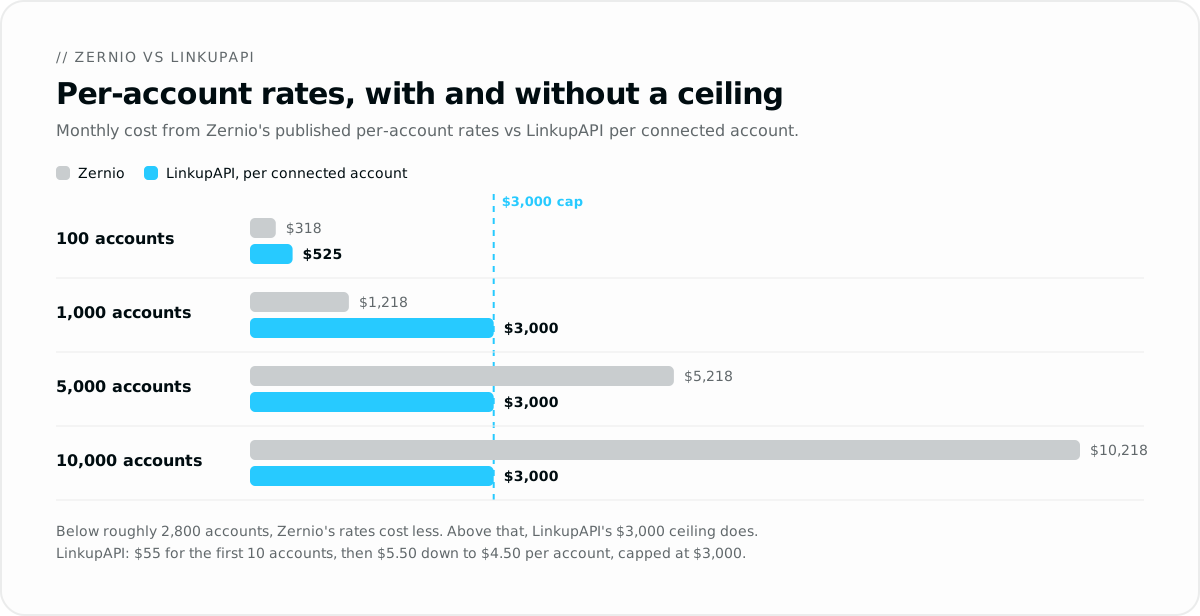
To be clear about the math: below roughly 2,800 connected accounts, Zernio's rates cost less. The capped bill wins above that line, and past about 640 accounts it stops moving with signups.
Price is the weaker reason to pick between them anyway. The jobs differ. Pick by what your product has to do on LinkedIn.
Where Zernio Remains the Better Tool
Stay on Zernio if publishing is the job: scheduling posts across channels, tracking engagement, managing ads, handling DMs on channels that expose them officially, like Instagram or WhatsApp. That is what it is built for, and its per-account rates are hard to beat at small and mid scale.
Keep it too if you run both jobs. A product can publish through Zernio and run outreach through a separate API. The two do not conflict, and neither replaces the other.
Move only the outreach side. There is no reason to migrate publishing to a tool that does not publish.
How Do You Add Outreach Alongside Zernio?
This is an addition more often than a migration. Your publishing integration stays where it is. The outreach side connects separately: link the LinkedIn accounts that will do the reaching out, then call outreach actions against them, the same connect-then-act model you already know.
- Read the documentation. The structure is account connection first, then invitations, messages, and email actions per account.
- Get your API key at linkupapi.com and connect a test batch of accounts.
- Wire account events. Checkpoint handling and webhooks are part of the API, so your product knows each account's state without polling.
- Start outreach on a small cohort, watch reply handling, then scale the number of connected accounts.
Builders comparing the wider tool market can start with our guide to the best LinkedIn outreach tools for AI agents.
Frequently Asked Questions
Does Zernio support LinkedIn outreach like connection requests and DMs?
Zernio connects to LinkedIn through official OAuth, which covers publishing, analytics, and comment management. Connection requests and direct messages to prospects are not part of that surface on LinkedIn. Zernio does handle DMs on channels that expose them officially, such as Instagram or WhatsApp.
How much does Zernio cost?
Zernio is usage-based with no plans: the first 2 connected accounts are free, accounts 3 to 10 cost $6 each per month, 11 to 100 cost $3, and everything past 100 costs $1. Ten accounts come to about $48 a month. Ads, phone numbers, calls, and SMS are metered separately.
What is the best Zernio alternative for B2B outreach?
For B2B outreach, LinkupAPI is the closest fit: connection requests, LinkedIn messages, and email and WhatsApp follow-ups in one sequence, priced per connected account and capped at $3,000 a month. For publishing across social channels, the closer rivals are SocialAPI, Ayrshare, bundle.social, or Postiz.
What is the difference between Zernio and LinkupAPI?
They solve different problems. Zernio publishes, analyzes, and manages ads across 16 channels through official OAuth. The other side runs B2B outreach: connect a LinkedIn account, send invitations and messages, and follow up by email or WhatsApp. Some products use one for each job.
Is Zernio good for AI agents?
For publishing, yes. It ships an MCP server and an SDK, and agent builders use it as the posting tool in public Claude Code setups. For outreach, an agent needs actions that official access does not provide on LinkedIn, so that side calls for an outreach-focused API.
If the job in front of you is reaching prospects rather than posting content, get your API key at linkupapi.com and test the outreach flow on a few accounts.
