Best Waalaxy Alternatives 2026: Pricing, Caps & When to Switch
Waalaxy's 2026 pricing and 800-invitation caps, the moment a team or product outgrows a Chrome extension, and the honest case for staying on it.
By The LinkupAPI Team · Reviewed by Eliott · Updated
Waalaxy is the easiest way one person can start prospecting on LinkedIn. Nineteen euros, a Chrome extension, 300 invitations a month. It works.
Then something changes. A second rep joins. An agency signs a fifth client. A product team wants outreach inside its own app. Each adds a seat and another 800-invitation cap.
That is the moment people search for a Waalaxy alternative. Not because Waalaxy broke. Because the job changed. This guide covers what Waalaxy costs in 2026, who it fits, when a browser extension runs out of road, and what a different kind of tool looks like: one an AI agent drives, priced per account, with a ceiling on the bill.
Key Takeaways
- Waalaxy runs as a Chrome extension, priced per user: Pro 19 EUR, Advanced 49 EUR, Business 69 EUR a month.
- Every plan caps invitations at 300 or 800 a month, including Business and Enterprise.
- An agent-first API is a different job: the agent decides who to contact, what to say, and when.
- Per-account pricing from $5.50 down to $4.50, with unlimited outreach, stops at $3,000 a month on the Unlimited plan.
What Is Waalaxy?
Waalaxy is a Chrome-extension LinkedIn prospecting tool that imports prospects, runs invitation and message sequences, and syncs results to a CRM, priced per user per month. It was built for one person automating their own LinkedIn account, and it does that job with very little setup.
The extension model is the whole design. Waalaxy acts inside your browser, on your LinkedIn session, at quotas it sets per plan. Close the laptop and the sequence pauses, unless you are on Business with the Cloud option.
Sequences chain visits, follows, invitations, and messages. You bring the list. Waalaxy runs the drip.
How Much Does Waalaxy Cost in 2026?
Waalaxy prices per user per month: Pro at 19 EUR with 300 invitations, Advanced at 49 EUR with 800, and Business at 69 EUR with 800 invitations plus email sequences. Quarterly billing takes 20 percent off, yearly takes 50 percent off. Enterprise is custom from five seats.
The published grid, from waalaxy.com/pricing and their help center:
- Freemium: free. The help center describes 3 actions a day per type; one third-party review reports 80 invitations a month. No real automation either way.
- Pro, 19 EUR per user: 300 invitations a month, about 11 a day, 25 email finder credits, unlimited campaigns, CRM sync.
- Advanced, 49 EUR per user: 800 invitations a month, 200 a week at most, 120 to 150 messages a day, live chat, Make, Zapier and n8n modules, 50,000 prospects.
- Business, 69 EUR per user: everything in Advanced plus LinkedIn and email sequences, 500 Dropcontact credits a month, Cloud, Team, auto-imports, multiple sender accounts.
- Enterprise: custom, five seats minimum, 10,000 email credits, team workspace.
One third-party review from April 2026 reports prices roughly doubled since mid-2024 while the free plan shrank, and lists a LinkedIn Inbox add-on at about 20 EUR. People are checking: "waalaxy pricing" is up 170 percent on Google Trends over twelve months.
Who Is Waalaxy Built For?
Waalaxy is built for an individual or a small team prospecting from their own LinkedIn accounts, one seat each, at a steady weekly volume. Founders, freelancers, and two-rep teams get the most out of it. It is not built for products, agencies at scale, or agents.
- Dripify and Expandi do the same job in the cloud, with a dedicated IP per account. Same per-seat logic, more safety plumbing, higher price.
- La Growth Machine adds email and calls per identity. Still a finished app you click through.
- Waalaxy is the cheapest, simplest entry in that group. A strength, not a flaw.
None of them is a programmable layer. You configure a sequence. The tool replays it.
When Do You Outgrow a Browser Extension?
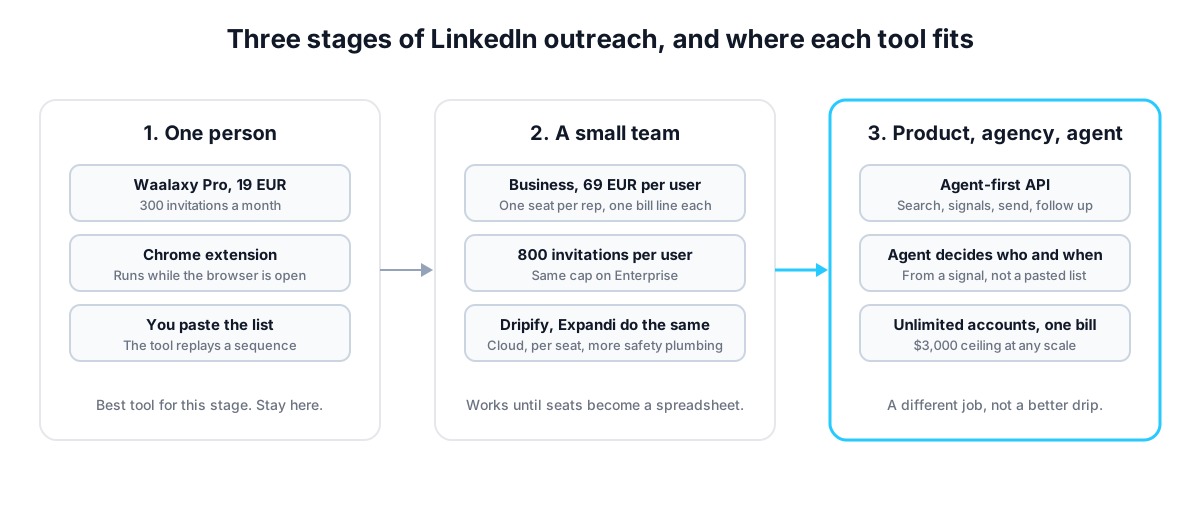
You outgrow a browser extension the day outreach stops being one person's task and becomes a system: several accounts, a product feature, or an agent that should pick the targets. At that point per-user pricing, per-account caps, and a Chrome dependency all start working against you.
The mistake most teams make is adding seats to fix it. A founder at a 15-person SaaS in Lyon started on Pro alone. Then two SDRs joined, then a partner agency. Four Business seats, four caps, four browsers kept open. As she put it: "I was paying per person for a thing I wanted running on its own."
Three signals you have crossed the line:
- You manage more than three LinkedIn accounts and the bill is now a spreadsheet.
- You want outreach inside your own product, for your own users, under your brand.
- You want an AI agent to choose who to contact from a signal, not from a list you pasted.
Why Is an Agent-First API a Different Job?
An agent-first API gives an AI agent structured LinkedIn, email, and WhatsApp actions it can call on its own: search, read a post's reactions, send a request, follow up by email. The agent decides who, what, and when. A drip tool replays a sequence you built by hand.
The difference shows in the input. Waalaxy takes a list. An agent takes an intent: "the 40 people who commented on our competitor's launch this week". It pulls the reactions, qualifies them, drafts a note that mentions the post, and queues the send. No list ever existed.
It also shows in where the thing lives. The API runs through MCP, so Claude, Cursor, or a custom agent connects in minutes. Builders call the same endpoints from their own backend, so a recruiting SaaS ships outreach under its own name. That is the product integration path no extension offers.
When we tested this with a two-rep team at a Series A dev-tools startup, the agent found 500 reactions on 12 rival posts, kept 40 engineering managers, and sent 40 requests that named the post. Waalaxy would have needed that list pasted in first. The agent-for-LinkedIn guide walks through the loop. Get your API key at linkupapi.com and point your agent at it.
What Changes When Pricing Has a Ceiling?
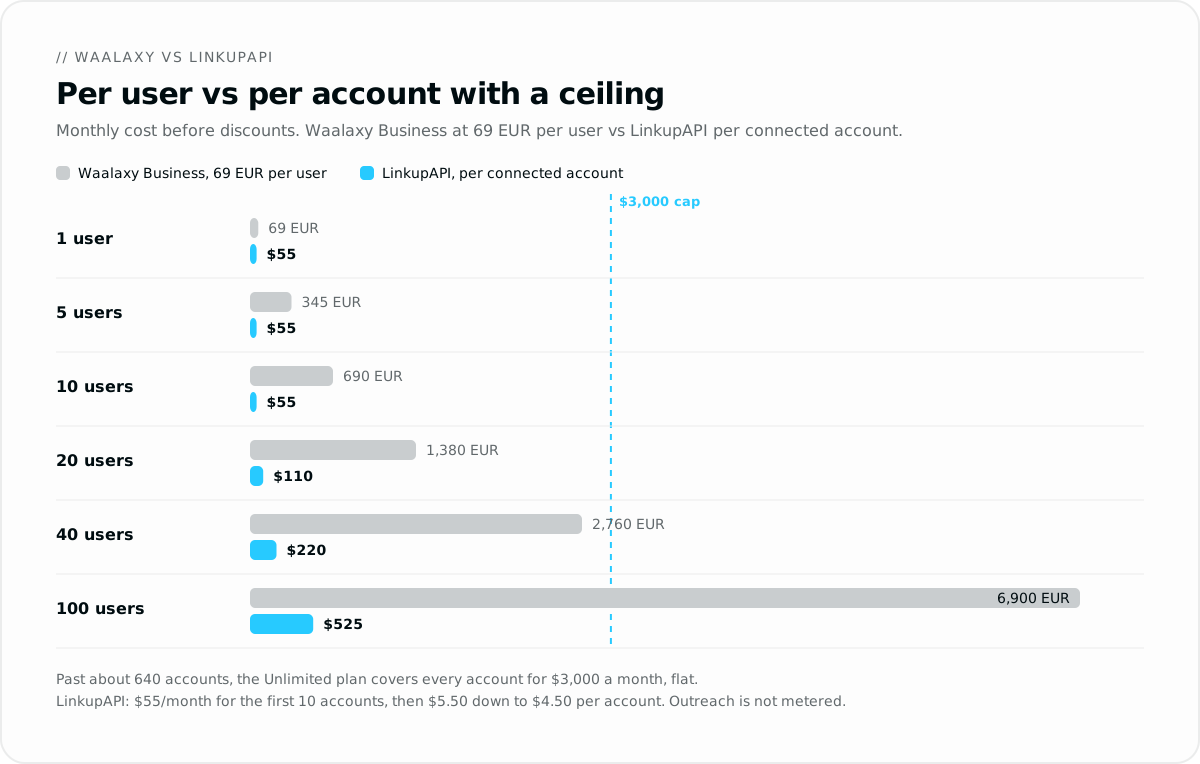
Per-user pricing grows in a straight line forever. A ceiling does not. LinkupAPI charges per connected account: $55 a month for the first 10, then $5.50 each up to 50, $5.00 up to 200 and $4.50 beyond, with unlimited outreach. The bill stops at $3,000 a month on the Unlimited plan, with unlimited connected LinkedIn accounts. No other tool in this category prices that way.
One more thing about the word unlimited. No tool in this category sells a true unlimited plan. HeyReach's top tier, for example, is capped at 500 senders under a fair-use policy, in the words of its own blog, and the terms above that are negotiated. One agency running about 900 accounts told us its bill there was already above $3,500 a month. The $3,000 Unlimited plan has no fair-use cap on connected accounts. That is the whole point of the ceiling.
Run the numbers on Waalaxy Business at 69 EUR per user, before discounts:
- 1 user: 69 EUR. Here, $55 covers up to 10 accounts. For one person who wants a dashboard, Waalaxy still wins.
- 5 users: 345 EUR. Five accounts here: $55.
- 20 users: 1,380 EUR, with twenty caps and twenty browsers. Twenty accounts here: $110.
- About 40 users: roughly 2,760 EUR. Forty accounts here: $220.
- 100 users: about 6,900 EUR. 100 accounts here: $525, and the bill never passes $3,000.
Each new account costs 69 EUR on one side and $5.50 or less on the other. Past about 640 accounts, it costs nothing here.
Honest caveat: the ceiling only matters if you have the accounts. Each account still works at the pace LinkedIn allows from one session. Scale comes from more accounts, not from pushing one harder.
The Honest Case for Staying on Waalaxy
Stay on Waalaxy if you are one person, or a team of two or three, sending a few hundred invitations a month from your own accounts. It is the cheapest entry in the category, the fastest to learn, and the freemium lets you try before paying. An API is overkill for that.
A solo consultant in Bordeaux sending 200 invitations a month has no reason to leave Pro. Nineteen euros. A sequence she wrote once. French-language support when something breaks.
The test in one line: if your outreach is a task, use Waalaxy. If it is a system, a product, or an agent, it is a different job.
How Do You Run a Side-by-Side Test?
Run the same week of outreach twice: one campaign in Waalaxy from a pasted list, one routine where an agent picks the targets from a signal and sends through the API. Compare replies, time spent, and cost. Four steps, about half an hour of setup.
- Get your API key at linkupapi.com and connect one LinkedIn account. All 50+ endpoints are open on every plan, from $55 a month for up to 10 accounts.
- Connect the MCP server in your agent. In Claude, Settings then Connectors. The same server works with any MCP-compatible agent such as Cursor or a custom build; ChatGPT uses Custom GPT Actions.
- Paste a prompt Waalaxy cannot run: "Find the people who reacted to the last 3 launch posts from our two main competitors. Keep the 30 heads of sales at 50 to 500 person companies in France. Draft a connection note for each that mentions the post, then queue them for my approval."
- Turn the conversation into a scheduled routine that runs every Monday morning, so the list rebuilds itself from fresh reactions instead of last month's CSV.
You are probably thinking this needs an engineer. It needs one key and one connector. The Unipile guide shows the developer side.
Other Waalaxy Alternatives Worth Comparing in 2026
If you are leaving Waalaxy because of the caps or the browser dependency, you are probably comparing the same shortlist everyone else is. Here is where each tool actually differs, without the marketing.
- HeyReach: cloud-based, LinkedIn-first, designed to run many sender accounts in one campaign. The natural next step for agencies, priced per sender. Our HeyReach pricing guide covers the math.
- Expandi: cloud LinkedIn automation with a dedicated IP per account and smart sequences. Closer to Waalaxy in feel, stronger on safety settings. Details in our Expandi comparison.
- Dripify: drip campaigns on LinkedIn with team analytics. Simple to run, per-user pricing. See the Dripify breakdown.
- La Growth Machine: multichannel sequences across LinkedIn, email and X, with enrichment built in. The best fit if Waalaxy's email step felt bolted on.
- PhantomBuster: not a sequencer but a library of automations and scrapers. Good for list building, weaker for conversation management. Our PhantomBuster guide explains the credit model.
LinkupAPI sits outside this list on purpose. It is the option when the outreach has to run inside your own product or agent rather than in someone else's dashboard, with per-account pricing that stops at $3,000 a month. Choose a tool above if you need a dashboard today. Read on if you need an API.
Frequently Asked Questions
How much does Waalaxy cost?
Waalaxy costs 19 EUR per user a month on Pro with 300 invitations, 49 EUR on Advanced with 800, and 69 EUR on Business with 800 invitations plus email sequences and 500 email credits. Yearly billing halves the price, quarterly takes 20 percent off. Enterprise is custom from five seats, and a freemium exists.
Is Waalaxy safe for my LinkedIn account?
Waalaxy runs as an extension inside your own browser session and applies per-plan quotas, up to 800 invitations a month. Its help center advises new accounts to hold each action type to about 30 a day at first. Like any automation on your own profile, safety depends on volume, pacing, and keeping to those limits.
Does Waalaxy have an API?
Waalaxy does not advertise a public developer API on its pricing page. Advanced and Business connect through Make, Zapier, and n8n modules, plus CRM sync. That covers moving data between tools. It does not let an AI agent or your own product call LinkedIn actions directly, which is the job an outreach API does.
What is the best Waalaxy alternative for AI agents?
For an AI agent, the closest fit is an API the agent calls through MCP: search, post reactions, connection requests, messages, email and WhatsApp, on every plan. LinkupAPI starts at $55 a month for up to 10 connected accounts, charges from $5.50 down to $4.50 per account after that, and tops out at $3,000 with unlimited connected accounts, so the bill stops growing with the accounts.
Waalaxy vs LinkupAPI: what is the difference?
They do different jobs. Waalaxy is a finished app for a person running sequences from a Chrome extension, priced per user with invitation caps. LinkupAPI is a set of structured actions an agent or a product calls, multi-channel, priced per connected account with a $3,000 ceiling for unlimited accounts. One is a tool you use. The other is a layer you build on.
Waalaxy is a good first tool. When outreach becomes a system, a product, or an agent's job, the shape has to change with it. Get your API key at linkupapi.com and give the agent the same week you just gave Waalaxy.
