Best HeyReach Alternative 2026: Pricing, Per-Sender vs Flat
HeyReach's per-sender pricing at 1, 10, 25, 50 and 100 accounts, the honest case for staying, and where an agent-first API with a flat $3,000 ceiling is a different job.
By The LinkupAPI Team · Reviewed by Eliott · Updated
HeyReach charges $79 a month per LinkedIn sender. Add a second account and the bill doubles. Add ten and it is $790. That is why agencies love it at three accounts and open spreadsheets at thirty.
Most people searching for a HeyReach alternative are not unhappy with HeyReach. They have outgrown its shape. Their agency runs fifty client accounts, or their product sends LinkedIn messages for hundreds of users, and a per-sender app was never built for that.
Key Takeaways
- HeyReach bills per sender. Growth is $79 a month per LinkedIn account, Agency is $999 for 25 senders, Unlimited is $2,999.
- The bill flattens only at the top. Below Agency, every account you add raises the price, and enrichment credits stay capped per sender.
- LinkupAPI is per account, capped at $3,000. Accounts cost from $5.50 down to $4.50 with unlimited outreach, and the Unlimited plan covers every connected account for $3,000 a month.
- They are different jobs. HeyReach is a finished app for teams. The API is for agents and products that embed outreach.
- Unlimited is not unlimited: HeyReach's own blog caps the top tier at 500 senders under fair use, and one 900-account agency reported paying over $3,500 a month.
What Is HeyReach?
HeyReach is a cloud-based LinkedIn outreach app that connects many sender accounts to one campaign, rotates leads across them, and gathers every reply in a unified inbox. It runs on HeyReach's servers with a dedicated proxy per sender, so campaigns keep going when nobody is logged in.
The company is based in Skopje, launched in 2023, and holds a 4.7 rating on G2. The pitch is aimed at lead generation agencies.
Sender rotation is the core idea. Ten accounts at fifteen invitations a day make 150 daily touches, each profile staying at modest volume.
How Much Does HeyReach Cost in 2026?
HeyReach costs $79 a month per sender on Growth, $999 a month on Agency with 25 senders included, and $2,999 a month on Unlimited. Quarterly and yearly billing bring those to $71 and $63, $899 and $799, and $2,699 and $2,399 respectively. The figures come from HeyReach's own pricing page.
What each tier includes:
- Growth, $79 per sender: all LinkedIn actions, unified inbox, 100 enrichment credits per sender, API and webhooks, a dedicated residential proxy per sender, 14-day trial with 3 accounts.
- Agency, $999: 25 senders, upgradeable to 50, 1,000 enrichment credits, whitelabel, bring your own proxies, a dedicated Slack channel.
- Unlimited, $2,999: unlimited senders, 3,000 enrichment credits, migration support, extra whitelabel brands as a paid add-on.
Two details matter. HeyReach bills per sender, not per user, so teammates and clients are free. And 100 enrichment credits per sender is a top-up, not a data source.
Who Is HeyReach Built For?
HeyReach is built for teams that run LinkedIn outreach from many accounts and want one screen for it: lead generation agencies, outbound teams with several reps, and operators managing client profiles. If a human opens a dashboard every morning to check replies, this is its category.
Neighbours help place it. Expandi sells the same cloud model at $99 per account. Dripify does it at $39 to $99 per user. La Growth Machine adds email and calls per identity. All are apps a person drives.
None of them is a building block. You cannot ship HeyReach inside your own product. That is not a flaw. It is not the job they took on.
Why Is an Agent-First API a Different Job?
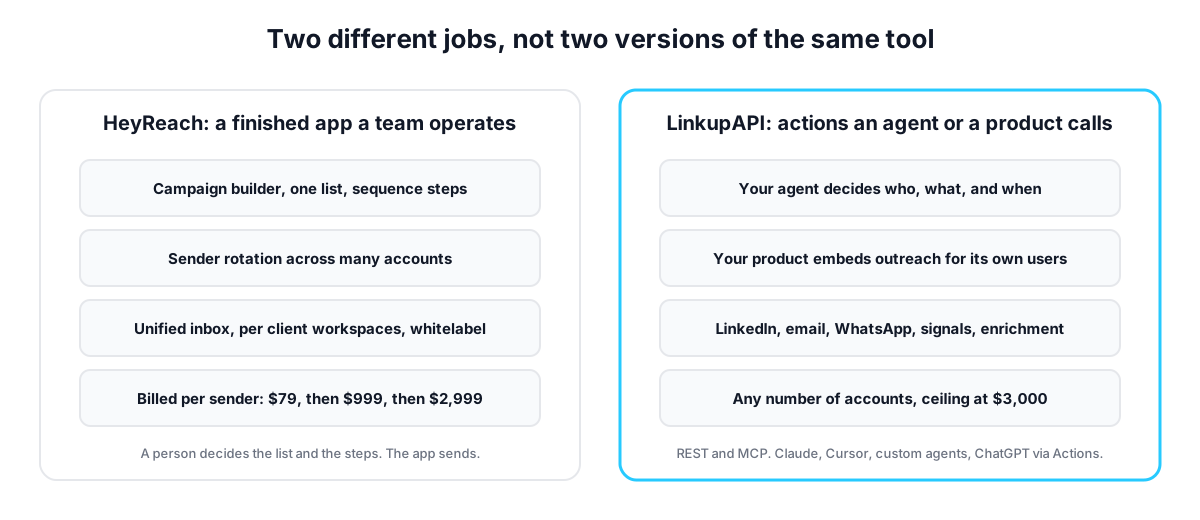
An agent-first API gives an AI agent or a product the LinkedIn actions themselves, as structured calls, instead of a campaign builder a person configures. The agent searches for people, reads who reacted to a post, sends the request, follows up by email, and decides all of it. Nobody clicks a sequence editor.
- Who decides. In a campaign app, a human picks the list and the steps. With an API, the agent reads a signal, say 300 people who commented on a rival's launch, keeps 40, and writes each opener.
- Where it lives. Inside your product. A recruiting SaaS can offer LinkedIn outreach to its own users, from their own accounts, with no second tab.
- How it connects. One MCP server plugs into Claude, Cursor, or a custom agent, and the same endpoints answer REST calls from any backend.
Take a SaaS founder in Berlin selling a sales assistant to 400 small companies. Each customer connects their own LinkedIn account. The product finds decision makers, sends requests, and moves quiet threads to email through one integration. No dashboard could sit in that path.
That is the pattern behind connecting LinkedIn to your product.
Setup takes about ten minutes. Get your API key at linkupapi.com and connect a first account.
What Does "Unlimited" Actually Mean at 10, 25, and 50 Accounts?
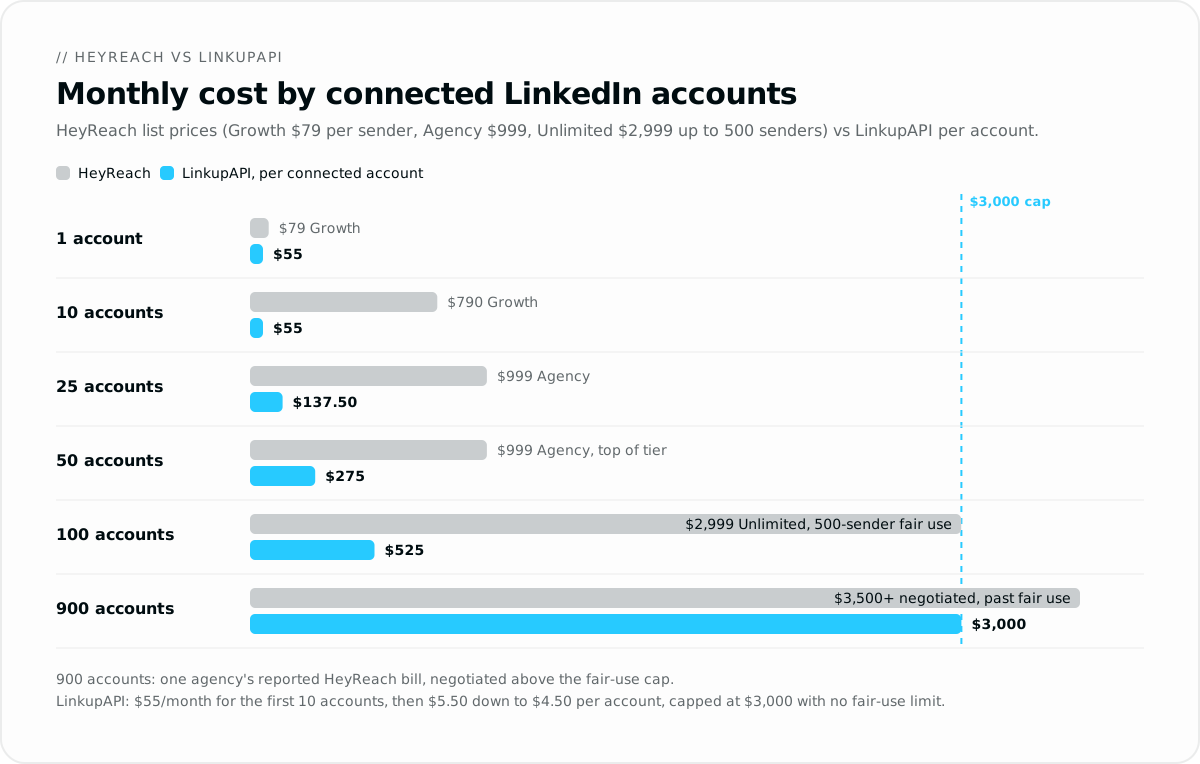
On HeyReach the bill rises with every sender until you reach the flat tiers. Ten accounts on Growth cost $790 a month. Twenty-five would cost $1,975, which is why Agency at $999 exists. Unlimited at $2,999 is the only tier where one more sender costs nothing.
Here is the part the pricing page does not say out loud. Unlimited is not unlimited. HeyReach's own blog describes the tier as capped at 500 senders under a fair-use policy, with a "contact us" above that, and third-party reviews note the exact thresholds are not published. One agency running about 900 accounts told us its HeyReach bill was already above $3,500 a month, and it was asking whether it could move. Past 500 senders the price becomes a negotiation. The $3,000 Unlimited plan here has no fair-use cap on connected accounts.
- 1 account: $79 on HeyReach. $55 here, which covers up to 10 accounts.
- 10 accounts: $790 on Growth. Still $55 here.
- 25 accounts: $999 on Agency. $137.50 here.
- 38 accounts: Growth would reach $3,002. Nobody does that; Agency exists for it. $209 here.
- 50 accounts: $999 on Agency, the top of its range. $275 here.
- 100 accounts: $2,999 on Unlimited. $525 here.
- 640 accounts and up: the bill here stops at $3,000 on the Unlimited plan, with no fair-use cap. HeyReach Unlimited stops at 500 senders.
The honest reading: on price alone the API costs less at every size, but price is not the whole comparison. The question is what the money buys: senders in an app with a unified inbox, whitelabel and enrichment credits, or connected accounts with unlimited outreach across 50+ endpoints with search, intent signals, email enrichment, and WhatsApp, driven by your agent. Email finding and verification are billed in credits on both.
One caution on the word unlimited. The sender cap goes away, and that is real. But enrichment credits stay capped at 3,000 and extra whitelabel brands are a paid add-on. Unlimited describes senders, not the whole bill.
What About the March 2026 LinkedIn Page Removal?
In March 2026, LinkedIn removed HeyReach's company page and several executive profiles. The CEO addressed it publicly, confirmed it had no effect on customer automations, and noted LinkedIn has done the same to other major tools. Customers kept running campaigns.
Worth knowing, not worth building a decision on. The useful question is how each tool treats your session, not whose page is up this month.
The Honest Case for Staying on HeyReach
Stay on HeyReach if your team lives in a dashboard, runs campaigns across many senders, and needs a unified inbox where anyone can reply for any account. That is a finished product with per-client workspaces and whitelabel, and no API replaces that operator experience.
An outbound agency in Lisbon running 30 client accounts is the clearest case. Account managers open the inbox at nine, triage replies, and book meetings. Agency at $999 covers all 30 senders with whitelabel. Moving them to an API would mean rebuilding an inbox they already have.
It also fits teams already on Instantly or Smartlead for email and Clay for enrichment. HeyReach slots in through native integrations and its own MCP server.
The mistake most teams make is picking on price alone. A $79 sender a person operates and a $5.50 account an agent operates are not substitutes. Ask who does the work.
How Do You Run a Side-by-Side Test?
You can test both jobs in an afternoon: keep HeyReach running for the campaign your team manages, and hand one agent-driven workflow to the API. Connect one LinkedIn account, give the agent a signal-based target, and compare what each produced by Friday.
- Get your API key at linkupapi.com. Every plan includes all endpoints, and $55 a month covers up to 10 connected accounts.
- Connect the MCP server in your agent (Claude: Settings, then Connectors). It works with any MCP-compatible agent; ChatGPT connects through Custom GPT Actions.
- Paste a prompt that runs a real workflow: "Find the 250 people who reacted to our competitor's product launch post this week. Keep the 40 who are Heads of Sales at 50 to 500 person SaaS companies in the UK. Send each a connection request that mentions the post, and if nobody accepts within five days, find their work email and follow up there."
- Turn the prompt into a scheduled routine so it runs every Monday, then compare acceptance and replies against the HeyReach campaign over the same week.
The Unipile alternative guide covers the messaging-pipe side, and best LinkedIn outreach tools for AI agents ranks the field by what an agent can call.
Frequently Asked Questions
How much does HeyReach cost?
Growth is $79 per sender a month, Agency $999 for 25 senders (up to 50), and Unlimited $2,999. Unlimited is capped at 500 senders under HeyReach's fair-use policy, per its own blog, so above that the price is negotiated. One agency at about 900 accounts reported a bill above $3,500 a month.
Is HeyReach safe for my LinkedIn account?
HeyReach runs in the cloud with a dedicated residential proxy per sender on Growth, rotates leads across accounts to keep each one at modest volume, and respects LinkedIn's limits. In March 2026 LinkedIn removed HeyReach's company page, and the CEO confirmed customer automations were unaffected. Keep daily volume sensible on any tool.
Does HeyReach have an API?
Yes. Every HeyReach plan includes an API and webhooks, so you can push lists in and pull campaign activity out. There is also a HeyReach MCP server that connects to Claude. The API drives HeyReach campaigns; it does not turn the app into a component you embed inside your own product for your users.
What is the best HeyReach alternative for AI agents?
For an AI agent, the closest fit is an MCP server with LinkedIn capabilities the agent can call directly: search, connection requests, messages, post reactions, and email enrichment. LinkupAPI exposes those as 50+ endpoints on every plan, connects to any MCP-compatible agent, and prices per connected account, from $5.50 down to $4.50 with unlimited outreach, capped at $3,000 a month.
HeyReach vs LinkupAPI: what is the difference?
HeyReach is a finished outreach app: campaigns, sender rotation, a unified inbox, and workspaces that a team operates, billed per sender. LinkupAPI is an API and MCP server that an agent or a product drives, with LinkedIn, email, and WhatsApp actions, per-account pricing from $5.50 down to $4.50, and a $3,000 Unlimited plan that covers unlimited accounts. Different jobs, sometimes used together.
HeyReach did not stop being good. Your outreach stopped fitting a per-sender app. Get your API key at linkupapi.com, connect an account, and let an agent work one real week.
